I like it when its noisy
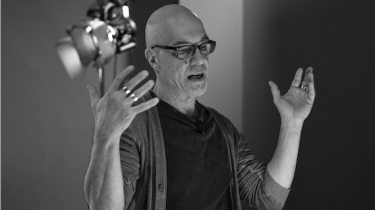
Katja Schneider: Micha, we just worked together on the publication “Housing the Temporary,” which is about your own story and the art form of dance. Maybe that's why I saw a lot in your latest piece, “splitter + stream / rhetorics of flesh” (2022), that has always been on your mind.
Micha Purucker: Yes, I was actually a little shocked when I noticed that. But it didn't have so much to do with the new beginning in the new building of the schwere reiter or our symposium, but rather that many things have flared up again since I worked on an early piece for “re.visited – work on mozart” last summer. It was a flashback to the 1980s, when it all started for me.
I still understand dance today as a kind of letting go.
KS: How did you experience the 1980s?
MP: It was a huge departure, both personally and in contemporary dance, in painting with the Wilden, and in music, which has always been very important to me; it had already saved me through the somewhat dull years of the Federal Republic of Germany. It was in the 1980s that I first started proper physical training—very late in life! I couldn't meet many of the requirements, which I was told straight away: you're too old, it's not possible anymore. But I grew up with the tail end of punk, where you could do lots of things even if you couldn't do them. For me, that meant self-empowerment. It was clear to me from the start that I didn't want to operate within the established movement canon – Graham, Cunningham, Nikolais, Horton, classical German expressive dance. I wanted something different, I wanted to let myself be carried by the impact of the music. The first piece I did while I was still in training was called “I Want Water” and featured music by African Head Charge, a cryptic London dub ensemble.
This opened up spaces and emotions that I couldn't access with conventional movement vocabulary, so it was clear that everything had to be connected to my own movement research. Industrial music by Test Dept., for example, was very interesting to me. I had the New Music Distribution Center in New York send me things that weren't available here, which is how I came into contact with Glenn Branca, Foetus, etc. very early on. I found the minimal structures that I had grown up with in a very elaborate form during my training with Jessica Iwanson in screeching guitars and drums. I wanted to find this outburst for myself. The music helped me a lot to lose myself in the movement. It was the time of raves, when people used to get high on music. I still understand dancing today as a kind of getting high.
How did you work in the studio?
We only had small windows of time in which we could work, so I provided a lot of material in advance. It was a very different kind of rehearsal than today. Everything was set, we counted everything at the beginning, which was terrible... We weren't trained at all for what we wanted to do back then. We spent hours warming up before rehearsals, then we got started. It was only later that I trained with the dancers, because the appropriate training systems didn't exist yet; they had to be developed first. It was this new beginning: asserting things, doing things, trying things that weren't (yet) available to us.
Where did the “stuff” come from? Who did you exchange ideas with?
Actually, only with the dancers. My references did not come from the theater world, and certainly not from dance. Film was very important to me – Derek Jarman, Chris Petit, experimental cinema in general. The escapism that cinema as cinema offers, the different kind of poetry – that's what interested me.
Applied to choreography, what are you looking for, what is the most important thing, your craft?
Embodiment. I see it as my task to present something that is an embodiment. I don't want to illustrate anything, not even music, even though that happened occasionally because I didn't have the time or experience at the beginning. You have to feed people and take them on a journey; you yourself have something in your head that has no reference point, but you still have to take others with you, even in production. I know what I want, but not how to get there. I see the craft in finding physical states and their articulation that correspond to what is being sought. I've always liked the phrase, “Dance is a state of excitement.” I see it that way too, and for this physical state, I have to find triggers that allow me to seduce the dancers into pursuing these states.
The embodiment makes an immediate statement, a statement in a specific situation. With regard to your work, the concept of situation has always been important to me, the frameworks you create, musically, through space, through objects. One enters a kind of wonderland, and at the same time you use avant-garde markers from theater and dance history, such as the catwalk in “stimulated identities” (2000). This does not result in sensory overload, at least not for me, but rather evokes physical, emotional, and intellectual responses in equal measure. How do such structures come about?
This situational aspect is absolutely crucial for me. I work with mood boards in the studio to expose us to influences that we pursue. For me, viewers are not spectators, but rather cohabitants. They behave more calmly than we do, but they are under the same roof as us, exposed to the same stimuli. The catwalk, for example, also refers to early reality TV formats. The original title of the piece in question was to be “stimulated identities, simulated identities,” because the media seduces us into a permanent parade in a very banal way. When I have this marker, the catwalk, it has an effect on the movement material and on different audience perspectives, so physical solutions have to be found here to complete the picture.
Your list of works includes almost 80 choreographies and productions that you have presented since 1986. Do you see your development as linear, or have there been significant breaks?
I don't see any break. I made the first film, “Failed Ascension” (1986), because I had imagined a scenario for which I couldn't find a stage space, so we went out to industrial wastelands and filmed there. That was the situation at the time, “industrial wasteland.” The “mental” and real space in which a choreography develops changes with each work. But I always needed a conception of space, an atmosphere, for all my pieces. What makes a big difference, however, is whether you work in a group or for small formats. You need totally different tools for that.
Can you describe it?
With five or six dancers, you start to look for patterns, and that results in a different way of working than when you stick to individual people. These are different approaches that also have an aesthetic impact. You can experiment more and focus in smaller formats; you also have to consider what clues to give the audience about how to view something. Looking for patterns in large productions is culturally ingrained; especially in dance, which is great, I really enjoy doing it myself, but it's also tricky because patterns usually look very good, often too good. Then the dance often becomes too smooth, too beautiful. It's important to counteract this so that it doesn't just become ‘visual porn’.
Do you make ‘visual porn’?
Well, I can do that too! The pieces I did in Korea, because they need ‘visual porn,’ and I really liked that. When we brought pieces from Korea here, it was always about how to get the ‘porn’ out. I wanted to emphasize the second level that it could have here, but even in the 1980s it was difficult to dance with irony.
Is it important to you to dance with irony?
In some cases, yes. I also found Korean porn ironic. For Koreans, it wasn't necessarily so. Loud, elaborate visuals are very contemporary and omnipresent in Korea. The same goes for the intertwining with pop culture back-up. For example, we worked to Giorgio Moroder and Rammstein, which was actually pure camp – smooth, but with a double meaning without cynicism.
How did you end up going to Korea in the early 1990s and working there repeatedly over the years?
A Graham teacher at Iwanson, Mina Yoo, greeted me after a performance of “Darwin Waltzes” (1988) and asked if I would create a duet for her and me. That worked out, and when she later established the dance department at Korea's first state university for the arts (then called the Korean National University of Arts), she invited me to teach there for a year. That became a permanent arrangement, so I ended up staying there for four years, also teaching at other universities, and co-founding the Laboratory Dance Projects, LPD Seoul. There are fantastic dancers there, and Korea still has a strong shamanistic tradition: being able and willing to lose oneself is very good for my work. There were large classes with very good people, all of whom are trained in a similar way and can therefore be very homogeneous if you want them to be. I do like it when there can be a rush in between, when synchronicity floods the stage, patterns flicker, etc. And it's no secret that it was becoming increasingly difficult in Germany to produce large pieces, to tour, to record again.
Why did you stop there?
They didn't like the last production I did for the LDP company, “murmurs + splotches” (2015). The physicality I started with has been incorporated into their movement repertoire. That gets passed on, and then you see epigones. The dancers can reproduce and exceed everything that is possible. They wanted a fresh start for the anniversary, which I choreographed. But it was a new voice. It was very reduced in places, and in others it was rattling – I think that was too radically different for them. That's strange, because traditional things can be very reduced.
Whether in group pieces, small formats, your films, or installations, I find that your work is permeated by an existential loneliness.
I hear that a lot. Ultimately, you are alone. I see it that way too. When we worked a lot with contact improvisation, as in “Unrest – a Garden” (1995), it was never in such a way that people really found or supported each other permanently. Everything is only temporary and precarious. There were two poles, astronauts in space and divers in the water, and we are in between. The diver is locked up, the astronaut is locked up, and in between we are with antennas for each other, but alone in the world and in our own skin. Physically, that's a fact. But it's not tragic at all. There was a moment in the piece when they shook hands; it was very loud and very optimistic. But I never directly address love and partnership in my work. There are enough other works, songs, and novels for that. My dancers don't have role profiles or anything like that either.
We began our conversation by looking at your own history. You also explored your work and what remains of it in “archival beach” (2015), a performative installation. Was that a necessary step?
I didn't bother with it for a long time; that only came when the City of Munich's option subsidy expired. I wanted to look at my things again, gather them together, and also sweep them out, clear them out. As a filter, I was actually interested in the statement in all its different formulations that people had tried to make over the years.
The embodiment that is the goal of your work?
Being a body. People talk much more about dance now than they used to; but for me, the speechlessness, this not speaking in dance, was always a big argument in favor of dance, because it leaves things more open. But even though people talk much more today, some things are not asked. For example, why does a choreographer choreograph and not paint? What body images do colleagues operate with? There is a lot of talk about the pieces, but there is a silence regarding motivations. That's why I co-founded the series “STANDPUNKT.e” to invite colleagues and discuss: Where do you get your ideas from, what is your background? Where does it come from? There is also still a lot to be done in terms of reception. Dance is fleeting—what are we talking about when we talk about dance? What do we see when we see dance? What are these processes and how do they work?
In conversations, you repeatedly mentioned Uexküll, Lassnig, Bacon, Debord ...
Dance as dance—that's what I'm trying to do, and it's connected to a certain view of humanity, a certain philosophical idea of being in the world. Dance as dance is quite profound and not as innocent and merely pretty as it is often portrayed. There are references: for me, these are people like Pasolini, Fassbinder, Jarman, the French philosophers, and many others I grew up with. And, of course, William S. Burroughs. His statement, “We try to make ourselves less stable,” is actually my working motto in all its possible meanings. Stability is precarious and only short-lived, but we have nothing else. Actually, you're stumbling. My dance is actually a stumble.
Katja Schneider conducted the interview in March 2022. She holds a doctorate in literature and a postdoctoral qualification in theater studies with a focus on dance studies and performance art, and currently teaches as a professor of dance studies at the HfMDK in Frankfurt am Main. As a freelance critic and editor, she has worked for the Süddeutsche Zeitung, Deutschlandfunk, tanzjournal, and tanz, among others, and since 2015 she has been the dramaturge for the DANCE München festival.